

Why missing chewing teeth are a serious problem
The loss of chewing teeth is often less noticeable than the loss of front teeth, because molars and premolars are located deeper in the mouth. However, their absence can create serious functional problems that affect the entire dental system.
Chewing teeth are responsible for grinding food properly before swallowing. When one or more of them are missing, the chewing load is redistributed unevenly. The remaining teeth are forced to take on additional pressure, which may lead to excessive wear, loosening, cracks, and even premature tooth loss.
This problem is not limited to the teeth alone. Over time, the absence of chewing teeth can also affect the gums, the bite, and the condition of the jawbone.
How tooth loss affects facial appearance and health
Missing posterior teeth can gradually change the way the face looks. When the chewing support is reduced, facial proportions may shift. This can contribute to asymmetry, a less defined facial contour, and the earlier appearance of wrinkles and folds.
Another important issue is digestion. Proper chewing is the first step in healthy digestion, and when food is not processed efficiently in the mouth, the digestive system may experience additional stress. For this reason, long-term tooth loss in the chewing area may indirectly affect general health as well.
The longer a missing tooth remains untreated, the higher the risk of complications in both function and appearance.
Why implantation is considered the most reliable solution
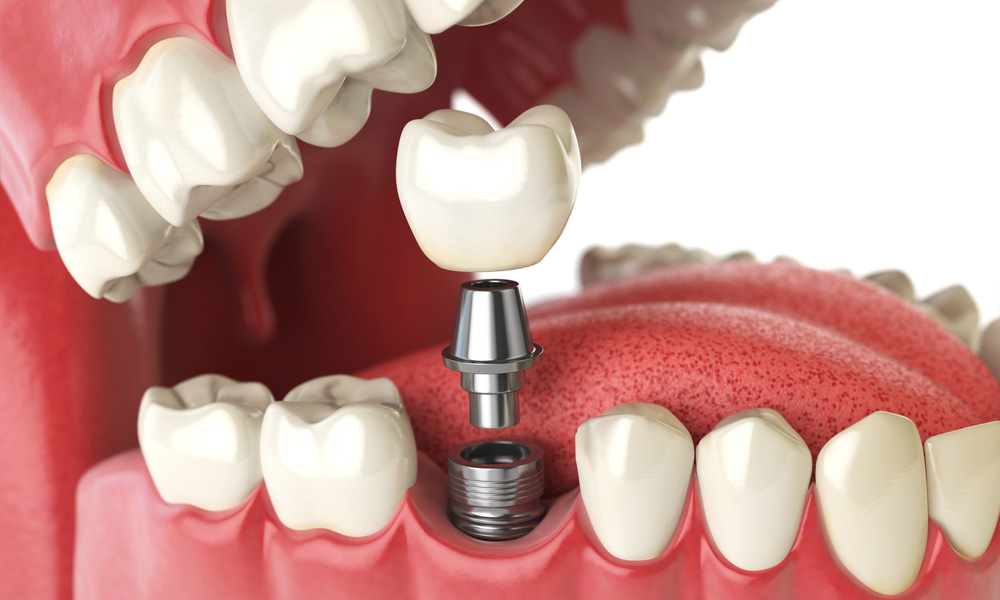
There are different ways to restore missing teeth, but implantation is widely regarded as one of the most effective long-term methods. A dental implant replaces the root of the lost tooth and provides support for a crown that functions as a new chewing unit.
Unlike removable or conventional bridge-based solutions, implantation allows the missing tooth to be restored without placing unnecessary stress on neighboring healthy teeth. This helps preserve the natural structures around the defect and improves the distribution of chewing forces.
Another major benefit is that implants help maintain the jawbone. After a tooth is lost, the bone in that area begins to shrink because it no longer receives normal functional stimulation. Implant placement helps reduce this process by transferring load back into the bone.
Special considerations for posterior implants
Implants placed in the chewing area must withstand significant daily pressure. Molars and premolars are exposed to much stronger functional loads than many other teeth, so the implant treatment plan must take this into account.
The implant itself must be stable and durable, and the restorative part placed on top must also be strong enough for constant chewing. This is why posterior implantation requires careful planning, precise technique, and appropriate material selection.
The location of the missing tooth also matters. The upper and lower jaws differ in anatomy, bone density, and surgical complexity, which influences how treatment is performed.
Implantation in the upper jaw
When a chewing tooth is missing in the upper jaw, treatment should ideally not be postponed for too long. The bone in the upper posterior region is generally thinner and less dense, and bone loss can develop relatively quickly after extraction or tooth loss.
If too much time passes, the bone may become too weak or too shallow for reliable implant placement. In such situations, additional procedures may be needed to increase bone volume before or during implantation.
The upper jaw also presents anatomical challenges because of its proximity to the maxillary sinuses. For this reason, implant placement in this area requires careful assessment and precise surgical planning.
Implantation in the lower jaw
The lower jaw usually has denser bone, which often provides good support for implants. This density can improve implant stability and may allow effective treatment even when the tooth has been missing for some time.
However, the lower jaw has its own anatomical risks. One of the most important factors is the position of the mandibular nerve. Implant placement must be planned in a way that avoids injury to this structure, because nerve damage can cause numbness, pain, or altered sensation.
So although the lower jaw often offers strong bone support, it still requires accurate diagnosis and experienced clinical execution.
Why timing is important
One of the key messages in implantation is that time matters. The sooner a missing chewing tooth is restored, the more treatment options are usually available. Early treatment may reduce the need for bone grafting and may simplify the overall procedure.
When restoration is delayed for years, bone atrophy becomes more likely. This can make treatment longer, more complex, and more expensive. It may also reduce the possibility of using more straightforward protocols.
In many cases, early implantation offers both biological and practical advantages.
What the treatment process usually includes
Implantation is not a single action, but a multi-stage treatment process. It begins with diagnosis, including examination, imaging, and assessment of the patient’s oral and general health.
The preparation stage may include treatment of cavities, gum inflammation, removal of hopeless teeth, and professional cleaning. Good oral hygiene and healthy soft tissues are essential before surgery.
After that comes the implant placement itself. Depending on the clinical situation, the procedure may follow different protocols. Once healing and integration are complete, a crown is attached to the implant to restore function and appearance.
Why posterior implants improve quality of life
Restoring chewing teeth with implants does more than fill a gap. It helps normalize chewing, improves comfort during meals, supports the bite, and protects the remaining teeth from overload.
Patients often notice that they can chew more confidently and more efficiently after treatment. In addition, because the implant-supported crown feels stable and does not rely on neighboring teeth, many people find it more comfortable than traditional alternatives.
In this sense, implantation is not only a restorative treatment, but also an investment in long-term oral function.
Conclusion
Missing chewing teeth should not be underestimated simply because they are less visible. Their loss can affect chewing, bone condition, facial balance, and the health of the remaining teeth.
Dental implantation is one of the most reliable ways to restore posterior teeth because it replaces both the root and the visible part of the tooth. When carried out in time and planned correctly, it can restore function, preserve bone, and support both oral health and everyday comfort.


