

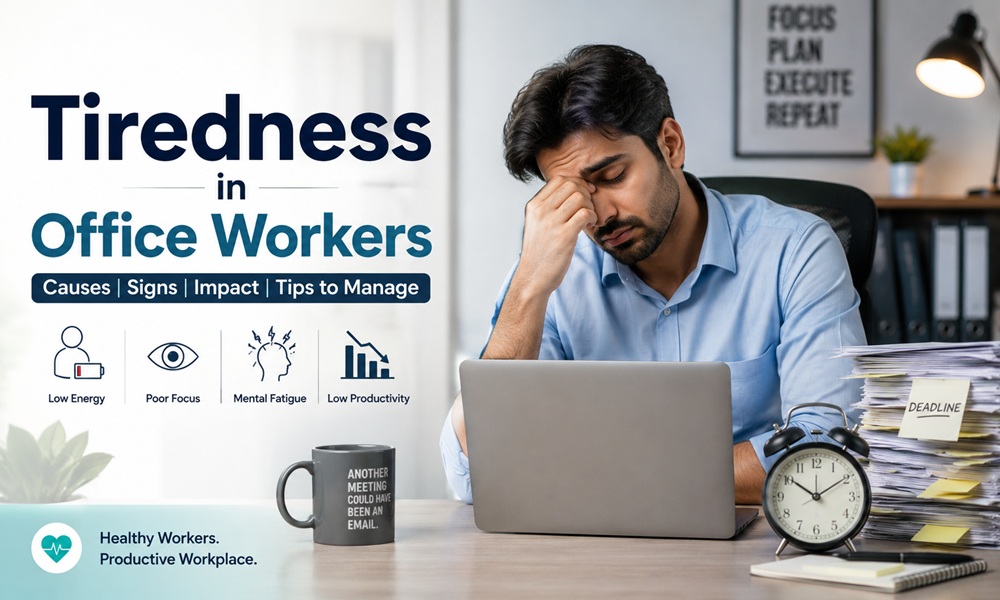
Why Office Fatigue Feels So Different From Other Tiredness
You sit at a desk most of the day, barely move, don’t carry anything heavy — and yet by 6 PM you’re more exhausted than after a weekend of physical activity. Office fatigue is real, but it’s not what most people think it is.
Most of the standard advice is built on myths. Let’s debunk them one by one — and replace them with what actually works.
Myth #1: ‘I just need another coffee.’
The reality
Coffee doesn’t add energy. It blocks adenosine — the chemical that signals tiredness. The tiredness builds up underneath; coffee just hides it. When the caffeine wears off (90 minutes), all that built-up adenosine hits at once. The crash is worse than the baseline tiredness.
What actually works
Limit to 1–2 cups before noon. Replace the second coffee with a 10-minute walk + glass of water. Walking is genuinely energizing — it boosts cerebral blood flow, releases endorphins, and the natural light reset helps.
Myth #2: ‘Lunch is causing my afternoon crash.’
The reality
Eating isn’t the problem — what you eat is. A 800-calorie biryani spikes blood sugar then crashes it. A balanced 400-calorie lunch sustains you for hours.
What actually works
Lunch should be 20% protein, 30% non-starchy veg, 50% complex carbs. Examples: 2 rotis + dal + sabzi + small curd; brown rice + grilled chicken/paneer + salad. Skip the rice-only or biryani-only choices.
Myth #3: ‘I just need to push through.’
The reality
Pushing through chronic fatigue compounds it. Cognitive performance drops 30% after 4 hours of continuous work without breaks. By hour 6, you’re working at the equivalent of mild sleep deprivation.
What actually works
90-minute work blocks with 10-minute breaks. Use breaks to walk, hydrate, stretch — not scroll your phone. This pattern from athletic performance research consistently outperforms ‘just push through’.
Myth #4: ‘It’s just my age.’
The reality
Age affects energy, but for working-age adults, the dominant factors are sleep, nutrition, hydration, vitamin D, B12, iron, and movement. Chronic fatigue at 28 or 38 is usually fixable, not ‘just life’.
What actually works
Get a basic blood panel: complete blood count (CBC), vitamin D, vitamin B12, thyroid (TSH), and ferritin. Most urban office workers have at least one deficiency, often vitamin D.
Myth #5: ‘AC office air is fine.’
The reality
Sealed AC offices recirculate stale air. CO₂ accumulates by afternoon and significantly reduces cognitive performance. Indoor air pollutants from carpet, paint, and electronics add to the load.
What actually works
Open windows for 5 minutes every 2 hours. Take outdoor walking breaks even if just 5 minutes. Air-purifying plants near your desk. Some research suggests CO₂ above 1000 ppm measurably impairs decision-making — common in afternoon conference rooms.
Myth #6: ‘I’m tired because I don’t exercise.’
The reality
Partly true, but more nuanced. Heavy exercise after long work days can worsen fatigue if sleep is short. The real fix isn’t ‘more gym’ — it’s daily movement woven throughout the day.
What actually works
Two 15-minute walks daily (morning + evening) help more than one big workout per week. Climb stairs when possible. Walk during phone calls. Aim for 8000+ steps.
Myth #7: ‘Energy drinks help when I’m really tired.’
The reality
Energy drinks are concentrated caffeine + sugar. The crash is harder, the effect on sleep is bigger, and they raise heart rate to unhealthy levels with repeated use. Linked to anxiety and cardiac issues with chronic use.
What actually works
If you absolutely need a boost: 1 cup black coffee + handful of almonds + glass of water + 5-minute walk. Sounds boring, works far better.
Myth #8: ‘Vitamins don’t make a difference.’
The reality
Random vitamins don’t. Correcting specific deficiencies absolutely does. Vitamin D deficiency causes fatigue in up to 40% of urban office workers. B12 deficiency causes profound fatigue. Iron deficiency is huge for women.
What actually works
Get tested. Supplement only what you’re deficient in, at the right dose, for the right duration. Improvement is often visible within 4–6 weeks. Don’t take random multivitamins as a hopeful guess.
Myth #9: ‘Naps are unprofessional.’
The reality
A 10–20 minute nap (no longer, or you wake groggy) restores cognitive performance to near-morning levels. NASA studies on pilots found 26-minute naps improved performance 34% and alertness 54%.
What actually works
If you can: find a quiet space at 2 PM, set a 15-minute alarm, close your eyes. Even if you don’t fully sleep, the rest restores energy. Some progressive offices now have nap rooms — for good reason.
Side-by-Side: Myth vs Reality
| The Myth | The Reality |
| More coffee = more energy | Coffee blocks tiredness, then crashes harder |
| Skip lunch to avoid crash | Wrong lunch causes crash, not lunch itself |
| Push through to be productive | Productivity drops 30% after 4 hours without breaks |
| I’m just getting older | Sleep, vitamins, and movement matter more than age |
| AC office is comfortable | CO₂ buildup measurably hurts focus by 3 PM |
| Heavy gym fixes fatigue | Daily small movement beats once-weekly gym |
| Energy drinks for emergency | They worsen sleep + fatigue over time |
| Vitamins are unnecessary | Targeted correction of deficiencies makes huge difference |
| Napping at work is lazy | 10–20 min naps measurably boost afternoon performance |
The Real Energy Schedule for a Typical Work Day
| Time | Strategy |
| 7:00 AM | Wake. Sunlight on face for 5 minutes. 1 glass water. |
| 7:30 AM | Protein-rich breakfast (eggs, paneer, oats with milk) |
| 9:00 AM | First coffee with breakfast or shortly after |
| 10:30 AM | Snack: fruit + nuts. Water. |
| 11:30 AM | 5-minute walk break |
| 1:00 PM | Balanced lunch (20% protein, 30% veg, 50% complex carbs) |
| 1:45 PM | 5-minute walk after lunch — don’t sit straight back |
| 2:30 PM | Power nap if possible (10–20 min only) |
| 3:30 PM | Buttermilk or green tea, not a 2nd coffee |
| 5:00 PM | Light snack: roasted chana, fruit |
| 6:30 PM | Leave office. 15-minute walk before commute if possible |
| 8:00 PM | Light dinner |
| 9:30 PM | Screen wind-down begins |
| 10:30 PM | Bedtime, dark cool room |
Movement Hacks for Office Workers
- Take phone calls standing or walking.
- Climb 2 flights of stairs once an hour.
- Park further from office; walk the extra 5 minutes.
- Set a ‘stand every 30 minutes’ alarm.
- Stretch at your desk for 30 seconds every hour.
- Walking meetings instead of conference room meetings.
| If Chronic Fatigue Persists
Tired more than 6 weeks despite good sleep, hydration, food, and movement — see a doctor. Anaemia, thyroid issues, sleep apnoea (often undiagnosed in office workers), chronic fatigue syndrome, depression, or rarely diabetes can all show up as ‘just tired’. |
FAQs
Q: Why am I always tired even though I sleep 8 hours?
A: Sleep quality often matters more than quantity. Screens before bed, inconsistent sleep timing, caffeine after 2 PM, or undiagnosed sleep apnoea can wreck quality. Get tested if quality concerns persist.
Q: Will switching to decaf help?
A: Possibly. If you suspect caffeine is the issue, switch to half-caf for 2 weeks, then decaf. If energy improves, you have your answer. Many heavy coffee drinkers feel better with less, not more, caffeine.
Q: Is the ‘afternoon slump’ avoidable?
A: Mostly. There’s a small natural dip around 2–3 PM (post-lunch dip is real but mild). What feels like a major slump is usually caused by heavy lunch, accumulated dehydration, or screen overload. All fixable.


