

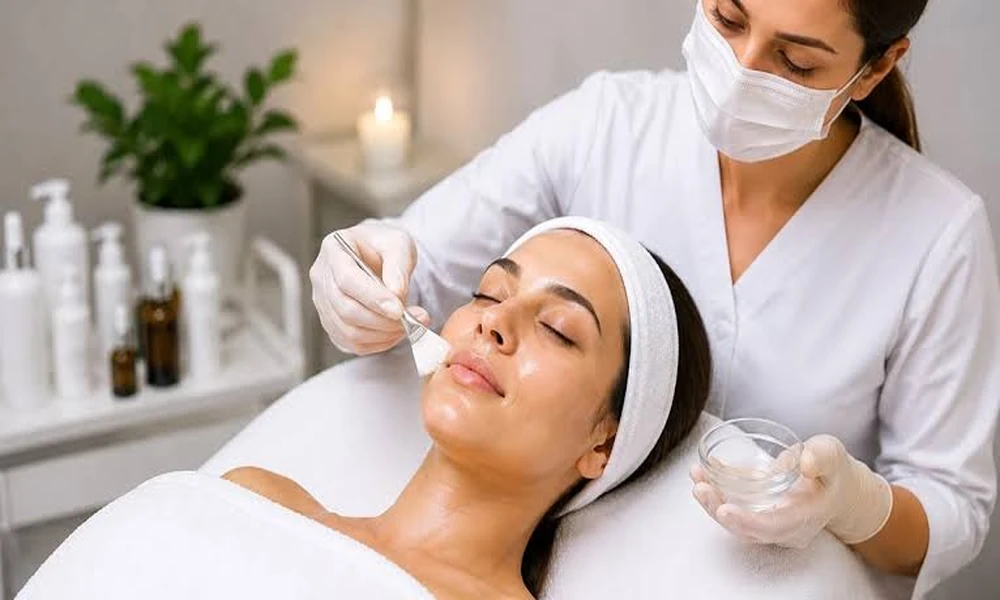
Is a “glow peel” just a fancier facial, or something stronger? It is a different thing altogether. A glow peel treatment is a superficial chemical peel: a mild acid solution applied to the face for a few minutes to loosen the outermost layer of dead skin cells so that smoother, more evenly toned skin surfaces over the following week. Unlike a facial, it works by controlled chemical exfoliation rather than massage and steam. This article covers what the peel is, the types used, what the session feels like, the downtime, who should avoid it and how it compares with a salon facial.
What “glow peel” actually means
“Glow peel” is not a single chemical. It is a clinic’s name for a light peel chosen to improve radiance, dullness, mild tanning, uneven tone and rough texture with little or no visible peeling. The acids are used at low concentrations and left on for a short time, so they act only on the epidermis. Deeper peels for scars and wrinkles are a separate category with real recovery time.
Types of superficial peels used for glow
| Peel | Typical strength | Best suited for |
|---|---|---|
| Glycolic acid | 20-50% | Dullness, mild tan, fine texture |
| Lactic acid | 30-50% | Dry, sensitive or dehydrated skin |
| Mandelic acid | 20-40% | Oily, acne-prone or darker skin |
| Salicylic acid | 15-30% | Blackheads, oily T-zone, acne marks |
| Combination or “party” peels | Blended low-strength acids | Quick brightening before an event |
A dermatologist chooses the acid and strength according to your skin type, how oily or sensitive it is and whether there are marks to address. People with oily, breakout-prone skin are often guided towards a salicylic-based option or an acne control peel, while those with stubborn tan or pigmentation may be offered a stronger brightening protocol such as a black peel on later visits.
What happens during the session
- Consultation. The doctor checks for active infections, recent sun exposure, pregnancy and any medicines such as isotretinoin.
- Priming. For darker skin tones, a sunscreen and a mild brightening cream are sometimes prescribed for one to two weeks beforehand to reduce the risk of post-peel darkening.
- Cleansing and degreasing. Make-up and oil are removed so the acid works evenly.
- Application. The solution is brushed on in layers and left for two to five minutes. You will feel tingling, mild stinging or warmth; a hand fan is often used for comfort.
- Neutralising. The acid is neutralised or washed off, and a soothing cream and sunscreen are applied.
The entire visit takes about 30 minutes. A course usually means four to six sessions at two- to four-week intervals, after which maintenance every one to two months keeps the glow.
What to expect afterwards
- Day 0: mild pinkness and tightness for a few hours.
- Days 2-4: light, dry flaking around the nose and mouth in some people; many see no peeling at all.
- Days 5-7: smoother, brighter skin as the new layer settles.
Downtime is minimal and most people return to work the same day. Make-up can usually be applied the next morning. Sunscreen is non-negotiable for at least two weeks, since freshly exfoliated skin tans quickly. Avoid scrubs, retinoids, waxing, threading, swimming pools and saunas for about a week, and do not pick at flakes.
Who should not have a superficial peel
- Anyone with an active cold sore, skin infection, eczema flare or open wounds on the face
- People who have taken oral isotretinoin in the past six months
- Pregnant or breastfeeding women, particularly for salicylic acid
- Those with a history of keloids or very reactive skin, unless cleared by a dermatologist
- Anyone with a fresh sunburn or who has waxed the face in the past week
- People expecting a deep scar or wrinkle correction; a light peel cannot deliver that
Indian skin tones are more prone to post-inflammatory darkening, which is why the peel strength is built up gradually over sessions rather than started at maximum.
Peel versus facial: which one do you need?
| Superficial peel | Salon facial | |
|---|---|---|
| How it works | Chemical exfoliation of the epidermis | Cleansing, steam, scrub, massage, mask |
| Done by | Dermatologist or trained medical staff | Beautician |
| Visible result | Builds over a week, lasts weeks | Immediate freshness, fades in days |
| Helps with | Tan, dullness, texture, mild marks | Relaxation, temporary hydration |
| Risk | Low when supervised; irritation if misused | Low; breakouts from heavy creams possible |
A facial is pleasant and relaxing, but it does not change the skin’s cell turnover. If the goal is evenness and a lasting brightness rather than a pampering hour, a peel is the more effective tool. Many people combine the two, using a chemical peel for glowing skin every few weeks and a hydrating facial in between.
Indicative cost
In most Indian cities a superficial peel costs roughly INR 1,500-4,000 per session, with combination or branded peels at the higher end. Packages of four to six sessions are common. These figures are approximate, vary with the city, clinic and the peel chosen, and the exact price will be quoted by the treating doctor after a skin assessment.
When to call the clinic
Mild stinging and pinkness are expected. Contact the clinic or a dermatologist promptly if you notice blistering, crusting, spreading redness, severe pain, or darkening patches that appear in the days after the session. Early treatment of these reactions prevents lasting marks.
Chosen for the right skin and done under medical supervision, a glow peel treatment is one of the simplest ways to restore radiance without surgery or downtime. Ask the clinic which acid they plan to use and why, and follow the sun protection advice to the letter.
Disclaimer: This article is for general information only and is not a substitute for medical advice. Please consult a qualified dermatologist before undergoing any chemical peel, especially if you are pregnant, have sensitive skin or are on acne medication.


